
A few years ago I thought that to compete against companies like Grainger or Fastenal we had to look more and more like them. More products. More brands. More inventory. Better prices. For a long time, that way of thinking helped us grow.
If a customer asked us for something, we would find a way to get it. If a new category appeared, we would add it. And when we competed against a larger company, our first reaction was often to lower the price.
Until we began to question something:
Does it really make sense for an SME to try to compete against a corporation by doing exactly the same thing they do?
I am increasingly convinced that it does not.
Competing on price alone has a limit
Those of us in industrial supply know this story well.
A request for quotation comes in. You look for the product, negotiate with manufacturers, calculate logistics, importation, lead time, and present your best proposal. Then you find out who you are competing against: Grainger, Fastenal, some national distributor, or even the manufacturer directly.
And the question comes up: "How much lower can I go?"
We have made that mistake too, and honestly we still keep making it.
We have cut our margin to win an order, and then you realize that yes, you won the sale, but you did not necessarily make a good deal.
Because if your main advantage was being 5% cheaper, the day someone shows up who is 6% cheaper, you will probably lose the customer.
There are things we simply cannot compete on. You also have to face the reality of things.
An SME does not have the buying power, infrastructure, inventory, or resources of a global corporation. To pretend to compete head-on against that would be naive. But we do not need to do that either.
The question we have started to ask ourselves is a different one:
What can we do that an organization of that size can hardly do with the same speed and flexibility we have?
That is where the conversation changes.
It has happened to us that a customer needs a product for tomorrow. That their usual supplier has no inventory. That they need to source something in the United States and bring it into Mexico. That they require a special part. Or simply that they have a problem and need someone to help them solve it.
In those moments the customer does not necessarily need the largest supplier. They need the supplier who solves the problem, and that is where a well-structured SME can be extraordinarily competitive.
The risk of wanting to sell everything
This has also been an important lesson for us. In wanting to solve our customers' needs, we began to expand into more categories. That has an advantage: you develop an enormous sourcing capability. But it also carries a risk.
Wanting to sell everything and ending up a specialist in nothing.
The answer we have found has not been to stop selling products. It has been to stop defining ourselves by them, because a glove, a tool, or an abrasive can probably be found with many suppliers. The important question is:
What value are we creating around that product?
Knowing the customer's consumption, keeping strategic inventory, anticipating replenishments, managing minimums and maximums, resolving an emergency, finding hard-to-source products, cutting lead times, using technology, helping the customer simplify their supply chain, and so on.
Then we are no longer talking only about selling a box or a product. We are talking about solving supply.
From winning an order to winning a relationship
We have also changed the way we understand a sale.
The question used to be:
How do we win this quote?
Today I find it much more interesting to ask ourselves:
How do we become a supplier that this customer wants to keep for the next ten years?
Because an order can be won on price. A relationship of many years is won by building trust, and when you know the customer's operation, understand their consumption, keep inventory, and respond when there is a problem, you start building something much harder to replace than a sale. A relationship.
Being hard to replace
We are still building this model, and we will surely keep making mistakes. But it is increasingly clear to me that our growth cannot depend on undercutting another supplier by a few pesos. It has to depend on how much value we are able to create around what we sell.
If a customer only remembers us because we were the cheapest, we are probably easy to replace. If they remember us because we solved a problem when they had one, because we know their operation, and because we are constantly looking for ways to make their supply more efficient, then we are building something different.
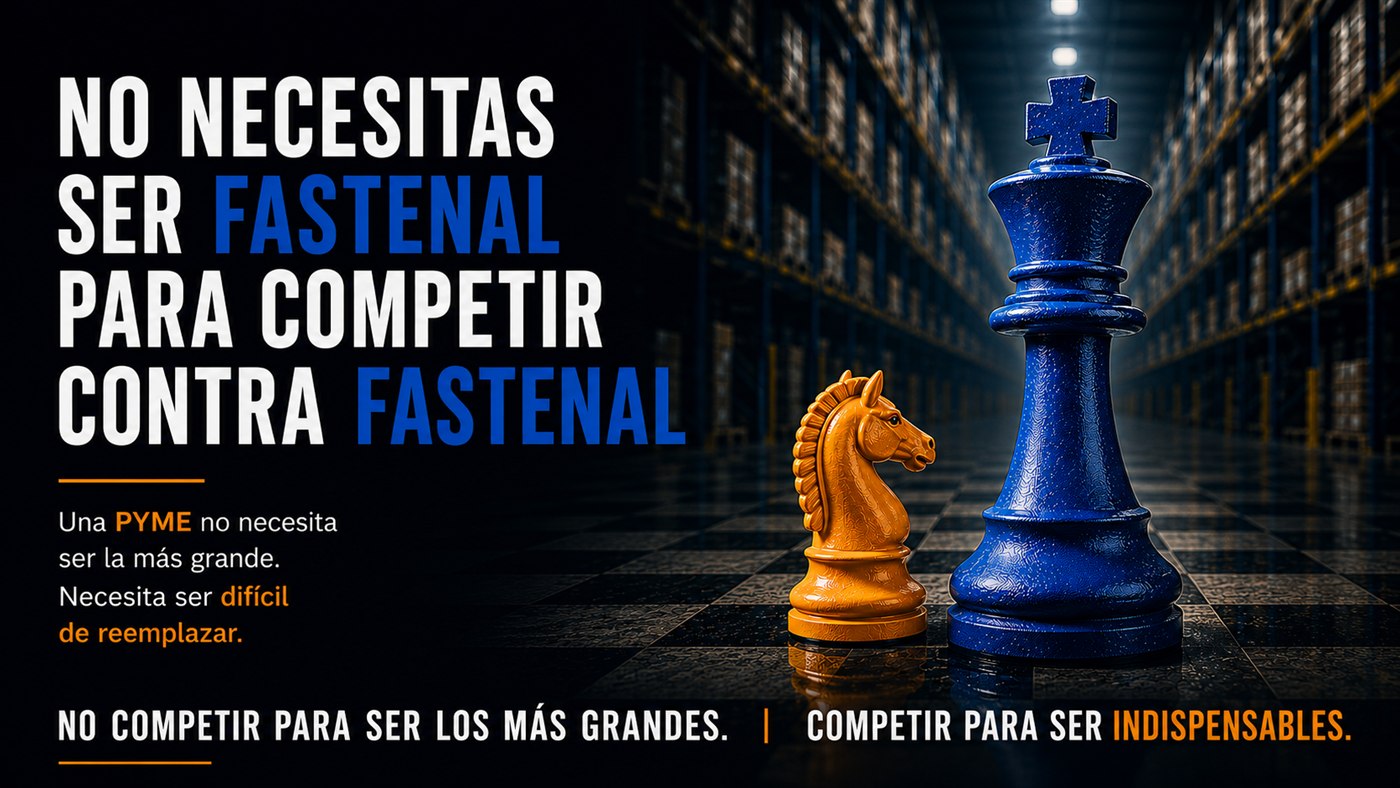
An industrial SME may be small next to a global corporation. But it can be enormously important to a customer's operation. We do not need to become Grainger or Fastenal.
We need to find what we can do extraordinarily well and build our company around it. Not competing to be the biggest. Competing to be indispensable.